
2008-11-24


2008-09-12
2008-08-06
Massenpsychologisches

WERNER HELDT
Meeting (Aufmarsch der Nullen)
um 1935
«Society is always a dynamic unity of two component factors: minorities and masses. The minorities are individuals or groups of individuals which are specially qualified. The mass is the assemblage of persons not specially qualified. By masses, then, is not to be understood, solely or mainly, "the working masses." The mass is the average man. In this way what was mere quantity- the multitude- is converted into a qualitative determination: it becomes the common social quality, man as undifferentiated from other men, but as repeating in himself a generic type.»Jose Ortega y Gasset, Revolt of the Masses
Source: WikipediaClassical theories
The main idea of Sigmund Freud's crowd behavior theory is that people who are in a crowd act differently towards people than those who are thinking individually. The minds of the group would merge together to form a way of thinking. Each member's enthusiasm would be increased as a result, and one becomes less aware of the true nature of one's actions.
Le Bon’s idea that crowds foster anonymity and sometimes generate emotion has become somewhat of a cliché. Yet, it has been contested by some critics, such as Clark McPhail who points out that some studies show that "the madding crowd" does not take on a life of its own, apart from the thoughts and intentions of members. Norris Johnson, after investigating a panic at a 1979 Who concert concluded that the crowd was composed of many small groups of people mostly trying to help each other.
However, it must be noted that if Le Bon often referred to the cliché of the irrational crowd, which was current in the 19th century and before (in particular in the fields of criminology, which tended to describe crowds as irrational and criminal groups), he considered himself the founder of "crowd psychology". Thus, he didn't consider crowds as totally irrational, but simply thought that ordinary individualist psychology wasn't relevant to this phenomenon. Le Bon was a pioneer in propaganda, which he considered a suitable and rational technique for managing groups, using for example communal reinforcement of beliefs, etc. Le Bon's 1895 The Crowd: A Study of the Popular Mind influenced many 20th century figures, including Adolf Hitler, whose Mein Kampf insisted on Le Bon's work.[1]
Wilfred Trotter, an English surgeon, wrote similarly, becoming famous for his book Instincts of the Herd in Peace and War. He introduced Wilfred Bion with whom he lived and worked, to the ideas of Sigmund Freud, and would later become personal physician to Freud. Wilfred Bion, and Ernest Jones, who also worked for Trotter, became influential figures in the British Psychoanalytic movement, and Bion who wrote a collection of papers on Experiences in Groups said that he was much influenced by Trotter.
Sigmund Freud would criticize Le Bon's concept of "collective soul", comparing it to the collective unconscious, asserting that crowds do not have a soul of their own, nor do specific ethnic groups have a Volkgeist. Rather, individuals identify themselves to their leaders through their own "ideal ego" (that is, their subjective representation of their leader). The Freudian concept of an "ideal ego" later became the super-ego. Ultimately, leaders themselves identify themselves to an idea.
Theodor Adorno criticized the belief in a spontaneity of the masses: according to him, the masses were an artificial product of "administrated" modern life. The Ego of the bourgeois subject dissolved itself, giving way to the Id and the "de-psychologized" subject. Furthermore, the bond linking the masses to the leader through the spectacle, as fascism displayed in its public representations, is feigned: "When the leaders become conscious of mass psychology and take it into their own hands, it ceases to exist in a certain sense... Just as little as people believe in the depth of their hearts that the Jews are the devil, do they completely believe in their leader. They do not really identify themselves with him but act this identification, perform their own enthusiasm, and thus participate in their leader's performance... It is probably the suspicion of this fictitiousness of their own 'group psychology' which makes fascist crowds so merciless and unapproachable. If they would stop to reason for a second, the whole performance would go to pieces, and they would be left to panic."[2]
Edward Bernays (1891 – 1995), nephew of psychoanalyst Sigmund Freud, was considered the father of the field of public relations. Bernays was one of the first to attempt to manipulate public opinion using the psychology of the subconscious. He felt this manipulation was necessary in society, which he felt was irrational and dangerous.
Convergence theory
Convergence theory holds that crowd behavior is not a product of the crowd itself, but is carried into the crowd by particular individuals. Thus, crowds amount to a convergence of like-minded individuals. In other words, while contagion theory states that crowds cause people to act in a certain way, convergence theory says the opposite: that people who wish to act in a certain way come together to form crowds.
An example of convergence theory states that there is no homogeneous activity within a repetitive practice, sometimes observed when an immigrant population becomes common in a previously homogeneous area, and members of the existing community (apparently spontaneously) band together to threaten those trying to move into their neighborhoods. In such cases, convergence theorists contend, the crowd itself does not generate racial hatred or violence; rather, the hostility has been simmering for some time among many local people. A crowd then arises from convergence of people who oppose the presence of these neighbors. Convergence theory claims that crowd behavior as such is not irrational; rather, people in crowds express existing beliefs and values so that the mob reaction is the rational product of widespread popular feeling.
Emergent-norm theory
Ralph Turner and Lewis Killian developed the emergent-norm theory of crowd dynamics. These researchers concede that social behavior is never entirely predictable, but neither are crowds irrational. If similar interests may draw people together, distinctive patterns of behavior may emerge in the crowd itself. Crowds begin as collectivities, acting, and protest crowds – norms may be vague and changing as when, say, one person at a rock concert holds up a lit cigarette lighter to signal praise for the performers, followed by others. In short, people in crowds make their own rules as they go along.
Decision-making, then, plays a major role in crowd behavior, although casual observers of a crowd may not realize it. Crowd behavior reflects the desires of participants, but it is also guided by norms that emerge as the situation unfolds. Emergent-norm theory points out that people in a crowd take on different roles. Some step forward as leaders; others become lieutenants, rank-and-file followers, inactive bystanders or even opponents. Each Member in the crowd plays a significant role.
References
- ^ See Serge Moscovici, L’Age des foules: un traité historique de psychologie des masses, Fayard, 1981
- ^ Theodor Adorno, "Freudian Theory and the Pattern of Fascist Propaganda" in The Culture Industry: Selected Essays on Mass Culture, London, Routledge, 1991, p.132

2008-08-05
Olympische Spiele bewirken Gutes?
Olympische Spiele 1936 

"The sportive, knightly battle awakens the best human characteristics. It doesn't separate, but unites the combatants in understanding and respect. It also helps to connect the countries in the spirit of peace. That's why the Olympic Flame should never die."
– Adolf Hitler, commenting on the 1936 Berlin Olympic Games
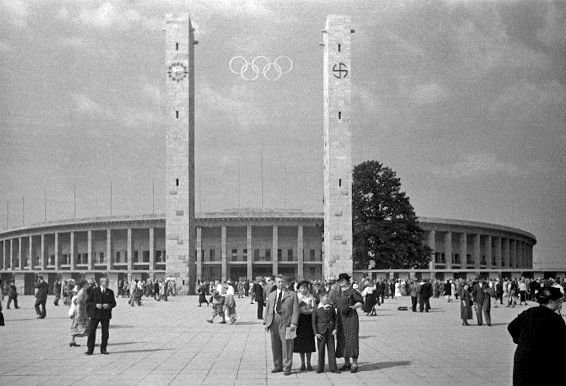

Die XI. Olympischen Sommerspiele in Berlin 1936
www.dhm.de/lemo/html/nazi/olymp/index.html
Als das Internationale Olympische Komitee (IOC) die Spiele am 13. Mai 1931 an Deutschland vergab, ahnte noch niemand, daß die Weimarer Republik 1933 von einem diktatorischen Regime abgelöst werden würde. Nach der Machtübernahme der Nationalsozialisten und den ersten Akten des offenen Antisemitismus gab es daher vor allem in den USA und Frankreich Boykottbestrebungen, die von zahlreichen deutschen Emigranten unterstützt wurden. Die Nationalsozialisten, die den olympischen Gedanken der Völkerverständigung stets als "geistige Verirrung" abgetan hatten, erkannten die Chance, mittels der Olympischen Spiele einen enormen Prestigezuwachs in In- und Ausland zu erreichen.
[...]
In einer knappen Abstimmung entschied sich die nordamerikanische "Amateur Athletic Union" im Dezember 1935 gegen einen Boykott der Olympischen Spiele, die anderen Staaten folgten diesem Beispiel.
[...]
Am 1. August eröffnete Adolf Hitler die Spiele vor 100.000 Zuschauern im Olympiastadion.
The History Place - Triumph of Hitler
www.historyplace.com/worldwar2/triumph/tr-olympics...The Games had been awarded to Germany by the International Olympic Committee back in May 1931, before Hitler came to power. It was the second time the modern Olympics were scheduled to be held in Germany. The 1916 Olympics scheduled for Berlin were canceled due to World War I.
Under Goebbels' direction, the Nazis intended to use the 1936 Summer Olympics in Berlin as a showcase for the "new Germany." The Nazis also hoped to profit from the tens of thousands of souvenir-hungry tourists who would bring much needed foreign currency into the country.
The Nazi Olympics
www.jewishvirtuallibrary.org/jsource/Holocaust/oly...On May 13, 1931, the International Olympic Committee, headed by Count Henri Baillet-Latour of Belgium, awarded the 1936 Summer Olympics to Berlin. The choice signaled Germany's return to the world community after defeat in World War I.
Two years later, Nazi Party leader Adolf Hitler became chancellor of Germany and quickly turned the nation's fragile democracy into a one-party dictatorship. Police rounded up thousands of political opponents, detaining them without trial in concentration camps. The Nazi regime also put into practice racial policies that aimed to “purify” and strengthen the Germanic “Aryan” population. A relentless campaign began to exclude Germany’’s one-half million Jews from all aspects of German life.
The Nazification of all aspects of German life extended even to sport. A staunch Nazi close to Hitler, Hans von Tschammer und Osten, headed the Reich Sports Office, which oversaw all sports bodies and clubs, including the German Olympic Committee planning the 1936 Games.
“German sport has only one task: to strengthen the character of the German people, imbuing it with the fighting spirit and steadfast camaraderie necessary in the struggle for its existence.” — Joseph Goebbels, Minister of Propaganda, April 23, 1933
The government harnessed sport as part of its drive to strengthen the “Aryan race,” to exercise political control over its citizens, and to prepare German youth for war. “Non-Aryans” — Jewish or part-Jewish and Gypsy athletes — were systematically excluded from German sports facilities and associations. They were allowed marginal training facilities, and their opportunities to compete were limited.
For two weeks in August 1936, Adolf Hitler's Nazi dictatorship camouflaged its racist, militaristic character while hosting the Summer Olympics. Soft-pedaling its antisemitic agenda and plans for territorial expansion, the regime exploited the Games to bedazzle many foreign spectators and journalists with an image of a peaceful, tolerant Germany.
Having rejected a proposed boycott of the 1936 Olympics, the United States and other western democracies missed the opportunity to take a stand that — some observers at the time claimed — might have given Hitler pause and bolstered international resistance to Nazi tyranny. With the conclusion of the Games, Germany's expansionist policies and the persecution of Jews and other “enemies of the state” accelerated, culminating in World War II and the Holocaust.
Nazi Olympics Berlin 1936
www.ushmm.org/museum/exhibit/focus/olympics1936/ VIDEO
VIDEOOpening of 1936 Summer Olympic Games in Berlin.
View Video
 AUDIO
AUDIOListen to Jewish athlete Gretel Bergmann describe her experiences in Nazi Germany.
View Audio
 AUDIO
AUDIOListen to U.S. Jewish athlete Marty Glickman describe his 1936 experiences.
View Audio
 PHOTO
PHOTOAdolf Hitler passes through the Brandenburg Gate on the way to the opening ceremonies of the Olympic Games.
View Photo

PHOTO
In the Olympic Stadium, German spectators salute Adolf Hitler during the Games of the 11th Olympiad.
View Photo
 PHOTO
PHOTOAt a ceremony during the 1936 Olympic Games, German spectators spell out the phrase, directed at Adolf Hitler, "Wir gehoeren Dir" [We belong to you].
View Photo
Dispute over boycott of the Olympics in the U.S.
en.wikipedia.org/w/index.php?title=1936_Summer_Oly...During the 1936 summer Olympics, there were many different views on whether the games should be allowed or discontinued. The people who voiced their opinions on the debate included Americans Avery Brundage, Ernest Lee Jahncke, and Judge Jeremiah Mahoney. The United States considered boycotting the Olympic games, since participating in the festivity might be considered as support for the Nazi Germany regime and its Anti-Semitic policies. However, others argued that the Olympic Games should not be a reflection of political views but strictly a contest of the greatest athletes.
Avery Brundage, President of the American Olympic Committee was against the boycott, stating that the Jewish athletes were being treated fairly and that the games should continue. Brundage believed that politics played no role in sports, and they should be considered two different entities during the controversial Olympics. He explained stating, “The very foundation of the modern Olympic revival will be undermined if individual countries are allowed to restrict participation by reason of class, creed, or race.”
1936 Nazi Color Film-Berlin in the Year of the Olympic Games
Nazi propaganda complete color film from 1936. An outstanding portrait of everyday life in Berlin in this rare, well preserved film, with the magical feeling of the pastel colors of Agfachrome.
Olympia 1936 - Fest der Völker/Feast of nations
The great opening ceremony of the 11th Olympic games in Berlin on August 1st 1936.INTERNATIONAL OLYMPIC COMMITTEE - OLYMPIC GAMES
www.olympic.org/uk/games/past/index_uk.asp?OLGT=1&...www.olympic.org/uk/utilities/multimedia/gallery/ph...

Berlin, Olympic Stadium, August 1936, Games of the XI Olympiad. Rival competitors in the long jump, German athlete Lutz LONG, 2nd, and Jesse OWENS of the United States,1st.
2008-06-22
2008-05-15
Das Trauma der Besatzer - Israelische Soldaten brechen das Schweigen
Shovrim Shtika: Traumatized members of the occupying (Israeli Defense) forces break the silence

Das Trauma der Besatzer
Israelische Soldaten brechen das Schweigen
Voller Idealismus traten sie ihren Militärdienst an, überzeugt davon, Israel könne sich nur durch Militärpräsenz in den palästinensischen Gebieten gegen Krieg und Terror wehren. Sie wollten "gute Besatzer", moralisch handelnde Soldaten, sein, doch Menschenrechtsverletzungen und Übergriffe durch die israelische Armee sind in Gaza und im Westjordanland an der Tagesordnung.
Mit der Organisation "Shovrim Shtika" wollen sie publik machen, was sie erlebten - der Alltag jenseits des Sperrwalls ist in Israel bis heute ein Tabu. Doch die jungen Soldaten wollen nicht nur die politische Situation vor Ort anprangern, sondern auch zeigen, wie Menschen durch einen Militärapparat zu dem werden, was einer der Soldaten als "Puppets on a String" (Marionetten) bezeichnet.
Produktion DLR Kultur 2007
Autor: Kai Adler
Israeli Soldiers Talk Of Abuses Of Palestinians By Military
www.cbsnews.com/stories/2005/07/11/listening_post/...[... A] year ago, soldiers Avichai Sharon, Yehuda Shaul and Noam Chayut organized an exhibition of photographs and soldiers’ testimonies from their military service in the West Bank city of Hebron. They acted for the sake of their own mental health and, they say, to force Israel to confront the truth about its policies.
Seven thousand Israelis went to see the exhibit in Tel Aviv. Since then, "Breaking the Silence" has attracted hundreds of new members and a lot of controversy.
The Israeli Defense Force is a conscript army. Every young Israeli has to do military service – two years for women, three years for men. Ever since the most recent Palestinian uprising in 2001 and the wave of suicide bombings that followed, soldiers posted in the West Bank and Gaza have done hard time – difficult and dangerous.
The problem, says Breaking the Silence, is that the conscripts believed they were going to fight a war; that they were soldiers of the most ethical fighting force in the world. Instead, many found themselves despised occupiers of disputed land.
“Who is the enemy?” asks Avichai Sharon. “I never saw the enemy. I saw society. I was three years fighting society in Palestinian cities.”
“Ninety-eight percent of the army’s energy is aimed against society. It’s even said among the higher ranks, ‘We will burn into the consciousness of Palestinian society that it’s not worthwhile to fight the IDF.’”
“It’s hard for me to pinpoint the worst thing I did”, says Avichai Charon. “It’s not the extreme cases. It’s the trivial day to day.”
“What haunts me? It’s the memories of 6-year-old, 7-year-old Palestinian children watching with tears in their eyes (video) when you’re tossing their room, breaking their wall, taking their father and slamming him into the wall before arresting him.”

Israeli conscripts break the silence
www.abc.net.au/am/content/2005/s1453259.htmYEHUDA SHAUL: Suddenly you realise that you are a monster. Suddenly you realise that the situation that you are part in took so much darkness from your soul.
[...]
Yehuda Shaul's mission was to fire grenades into the Abu Sneineh residential neighbourhood of Hebron.
YEHUDA SHAUL: It's not a game, it's a grenade machine gun. I did it every night for three… almost three months. Every night around 50 grenades inside a neighbourhood. That was my first experience in Hebron.
AHARON BLEMKER: When you kill someone you get to put an X on your weapon, and then you get a lot of honour from your mates in the squad and from everywhere you go.
AHARON BLEMKER: At night we put snipers in the roof, and one sniper killed a guy from about 300 metres, and I can tell you from experience at night from 300 metres, even with night vision, you can't see if a guy has a weapon or not.
So here's someone walking down the street, and he shot him, and then he was very proud about how he saw the whole head explode.
AVICHAI SHARON: When you put normal people, good people in a corrupt situation they have no other alternative but to be corrupt.
AVICHAI CHARON: And you're throwing 6-year-olds, women, children, elderly people into the street, and then you're closing them in their own house, in jail. And even for a 60-year-old person that wants to pee right now, they have to ask permission.
You stop thinking of it as people's homes, as people's lives, 'cause you can't deal with it anymore, you can't cope with 6-year-olds that look into your face with tears in their eyes. So you don't look at them.
YEHUDA SHAUL: It's like the feeling that we know that there's some shit is going on there in our backyard, but please don't disturb our lives. And you go out to a weekend, you laugh the weekend, you act like a normal person, and then Sunday you put on your uniform, cross the green line again, and again become a monster. And no one wants to talk about it, no one wants to feel about it.
Breaking silence over the horrors of Hebron
www.independent.co.uk/news/world/middle-east/break..."I'd go into a [Palestinian's] house and say, 'Look, I want all the children to go into one room now, I want to check out your house.' And I think: if it was the other way round, I don't know what I'd do. Really. I'd go nuts if anyone came into my house [like that]. I tried to imagine my parents, my family, what they'd actually do, if people with guns came into a house with little kids [in it] - little kids, four or five years old - and pointed weapons at them and said, 'OK, get moving everyone!' I found that part really hard... ."
"The day I understood that I simply enjoyed the sense of power, I was ashamed of myself. I don't believe in it, I don't think it's right to do anything [bad] to anyone, and certainly not to someone who hasn't done you any harm. But you can't help but enjoy it. People do what you tell them. You know it's because you've got a gun. You know that if you didn't have a weapon and if you didn't have your comrades beside you, they'd jump on you and beat you up and stab you and kill you - [but] you begin to enjoy it. Enjoy is not even the word. You need it. Then, when someone suddenly says 'no' to you, [you think], what do they mean, 'no'? Where did you get the cheek to say 'no' to me? Forget for the moment that I think that those Jews [the settlers] are crazy, and that I want peace and for us not to be in the territories - what do you mean by saying 'no' to me? I'm the law! I'm the law here! It's then you begin to understand that you like it ...."
"And this is where a soldier's maturity and discretion comes in - something I'm not sure always exists. There are a lot of catastrophes here, because the moment you give an 18-year-old such power, he can do dreadful things... ."
"The crazy thing is that you're standing there, a soldier in the Israel Defence Forces, OK? You've got a gun, loaded and cocked and what - are you an idiot? How dare you not listen to me? I can shoot you at any moment. I can just beat you with my gun butt, and chances are my platoon commander will pat me on the shoulder and say, 'Man, finally you've done something properly.' I'm just a kid, I hardly know anything about life, the only power I've got is my uniform and my gun, and because of this, I get to decide."
"What I'm used to here, that's to say, democracy, vanished in Hebron. The Jews did what they liked, whatever they liked, quite simply, there are no rules."
"What I understood in the end, after six months there, [was] that actually we have to protect the Palestinians from attacks by the Jews there, not protect the Jews... ."
"The people whose houses you go into, there's no difference, they're not people of a different kind. These people are even physically like my grandfather ... the old man who has to beg you to let him through the checkpoint, or who shows you an X-ray picture and you don't understand why ..."
Breaking The Silence - Israeli soldiers talk about the occupied territories - Testimonies
www.shovrimshtika.org/testimonies_e.asp?cat=16Kids' games
Rank: Sergeant
Unit: Nahal brigade
Place of incident: Atarot-Kalandia
Description:
10/2000
There wasn’t really a checkpoint in Kalandia [at that time]. We would stand there at the fence of the airport, as if this was aiding the guys who were guarding the airport. There were riots and we would shoot... how do you call it -
Rubber [rubber coated metal bullets].
Rubber, stun grenades. And all the time we were playing ‘Catch’ with the kids throwing stones. We would set traps for them there.
What do you mean by traps?
Traps, let me give you a somewhat funny example. We would put a can with a stun grenade inside, take out the safety pin, and place on it sweets, desserts that we would take from the kitchen. Then the kids would come, look at them and when they picked it up, the grenade would explode in their face.
Breaking The Silence - Israeli soldiers talk about the occupied territories - Testimonies
www.shovrimshtika.org/testimonies_e.asp?cat=22The Sniper
Rank: First sargent
Unit: Givati brigade
Place of incident: Gaza strip
Description:
end of 2003
The orders were not to shoot into the houses. They said: Tell the soldiers not to shoot into the houses because somebody could get hurt.. they didn't put too much time or attention to it. I confess that me too, when the sniper would shoot, I would start to spray, I wouldn't exactly see, you're with your M16 or with the Machine gun, you don't check, you simply fill the place up with holes. They would fill up the place with holes, shoot into windows, there were soldiers who would aim especially into the windows.Did the commander know this? The officers?
Yes.
Breaking The Silence - Israeli soldiers talk about the occupied territories - Testimonies
www.shovrimshtika.org/testimonies_e.asp?cat=19The Body Extractor
Rank: Lieutenant
Unit: paratroops elite unit
Place of incident: Nablus
Description:
2002
There has been a situation where a few people got killed – like, bodies that were in our range.
On the street?
On our street, right under our noses… and every now and then someone would come to pull the bodies outside. He apparently managed to pull one body out. The unit commander – who joined the force I was then with – he said that if it happened once more [a body pulled out] then we are to shoot the guy; even though he is not armed.
Breaking The Silence - Israeli soldiers talk about the occupied territories - Testimonies
www.shovrimshtika.org/testimonies_e.asp?cat=19Revenge
Date: 2/19/2002
Rank: lieutenant
Unit: Paratroop Reconnaissance Unit (SayeretTzanchanim)
Place of incident: Palestinian check point in the Nablus area
Description:
We heard about the (Palestinian) attack at Eyn Arik from our radio news reports. The following night….we received the Operation Order. For the same night. The Order called to approach three Palestinian checkpoints, manned by Palestinian Police in the Nablus area, from what I remember: approach three positions, and shoot at the Palestinian Police.
Who gave the order? The commanding officer of the Unit?
The commanding officer.
Breaking the silence
www.wdr5.de/sendungen/feature/manuskript/das_traum...Avichai: At the beginning it’s shocking, at the beginning, it’s difficult. The first time you see a child in your weapon’s sight, you’re shocked, you freeze. But after once, twice, ten, a hundred times, it’s a routine. Cause you stop feeling, it becomes a routine.
Am Anfang ist es schockierend, es ist schwierig. Wenn du das erste Mal ein Kind im Zielfernrohr deines Gewehres auftauchen siehst, bist du schockiert, du erstarrst. Doch nach dem ersten, dem zweiten Mal, nachdem das zehn, hundert Mal passiert ist, wird es zur Routine.
Aaron: You start acting like you are a king.You know it’s wrong. But in this situation, it’s just part of this situation.
Du fängst an, dich wie ein Herrscher aufzuspielen. Auch wenn du weißt, dass es falsch ist. Aber hier gehört es zur Situation dazu.
Avichai: Day in day out, you stop feeling. And when you stop feeling, then you become worse. And worse and worse. When you go downhill, when you go morally downhill, nothing stops you, it just escalates and escalates like violence. It escalates and escalates.
Tag um Tag hörst du auf, etwas zu empfinden. Und wenn du nichts mehr empfindest, beginnt dein moralischer Abstieg, es ist wie ein Sog, nichts hindert dich mehr. Die Dinge eskalieren, die Gewalt eskaliert.
Yehuda: I remember myself standing there, I just arrived, my company was briefing me. Look Yehuda, our mission is every night they shoot towards the settlement, we shoot back. (…) They shoot, we shoot them. And I remember myself, first moment I was shocked. (…) It’s an open area where people live. At my right the machine gun, granade machine gun, besides a pile of granades that are waiting to be fired by me. I looked down to the garden of the school: Piles of shells of granades that were fired by the forces before me in the same barrack.
Ich erinnere mich noch daran, wie ich das erste Mal dort stand und von meiner Kompanie erklärt bekam, was meine Aufgabe sein würde: „Schau, Yehuda, jede Nacht schießen die Palästinenser in Richtung der Siedlung, wir schießen zurück. Sie schießen, wir schießen.“ Und ich erinnere mich an diesen ersten Moment - ich war schockiert: Wir standen inmitten einer Wohngegend. Zu meiner Rechten war das Maschinengewehr - ein spezielles Maschinengewehr, mit dem man Granaten schießt. Daneben lag ein Haufen Granaten, die darauf warteten, von mir abgefeuert zu werden. Und im Schulhof ein weiterer Haufen leerer Granathülsen, die bereits von den Einheiten vor uns abgefeuert worden waren.
Yehuda: The first moment I heard my mission, I was shocked./ Now we have to understand that a machine gun is not an accurate weapon. You weigh into the area of your target and then you fix your endings, when you see, it fits. So you shoot the area, then you see where it hit. You go to the right again, a bit to the left and you try again. (…) So when I was trained on this machine gun, in order to shoot 3 granades – somewhere in the middle of the desert of Israel – no one is allowed to be in the distance of a kilometer and a half away at each side of the target. And there I am standing inside a neighbourhood where people live.
Als ich das erste Mal von meiner Mission hörte, war ich schockiert./ Ein Granaten-Maschinengewehr ist keine akkurate Waffe. Du zielst in eine bestimmte Richtung, schießt und siehst, wo es eingeschlagen hat. Dann korrigierst du dich, gehst ein wenig nach rechts oder links und probierst es ein weiteres Mal. Als man mich an dem Granaten-Gewehr trainiert hatte - inmitten der israelischen Wüste - durfte niemand im Radius von anderthalb Kilometern des Zieles stehen. Und hier stand ich auf einmal inmitten einer Wohngegend.
Avichai: The first time I think that I had any doubts (…) was a few months before operation defensive shield. At the end of 2001.
Das erste Mal, dass mir Zweifel kamen, war Ende 2001, kurz vor der Militäroperation „Schutzschild.“
Avichai: After a suicide bombing, we got a briefing that we are going to take over the refugee camp of Jenin. At that briefing, they told us to get in, take over houses, each platoon was to take over a different neighbourhood. Take over a house for a week, 2,3, weeks – no one knows for how much time – and use that house as an army barrack. As long as we were there, the family is jailed in the house inside one room, under guard all times. And the whole idea of us being there was to create, and that’s what was told to us in the briefing – was to create, to be provocative towards society. To punish the Palestinian society in that area. So that they will feel the pressure on them. Every time there will be a different squad that will be inside the house, using that as an army barrack, securing the whole neighbourhood, and there will be a different squad patrolling the neighbourhood, doing violent patrols, shooting in the air, going into houses for no reason, stopping people, inforcing curfew – trhowing granades into the streets, to frighten the population. And in the briefing, it was said also that most probably, there will be demonstrations, because the people will get pissed off of course. And then they’ll go towards the house, throwing stones and whatever – and in my unit we never had non-lethal or less lethal ammunition. We never had tear gas, we never had rubber bullets. All we had was life ammunition. And the order was to shoot at the organizers of these demonstrations.
Nach einem Selbstmordattentat bekamen wir die Aufgabe, das Flüchtlingslager von Jenin einzunehmen. Jede Einheit sollte für eine andere Nachbarschaft zuständig sein: Wir sollten Häuser für ein, zwei, für drei Wochen besetzen und dort unsere Armeestützpunkte errichten. Solange wir da wären, würde die Familie in einem Zimmer des Hauses eingeschlossen und die gesamte Zeit über bewacht werden. Die Idee war, dass wir Angst verbreiten und die Bevölkerung für das Attentat bestrafen sollten. Außerdem sollten gewalttätige Straßenpatroullien stattfinden: Wir sollten in die Luft schießen, Leute aufhalten, grundlos Ausgangessperren verhängen und Granaten in die Straßen werfen. Und natürlich, so sagte man uns, würden die Palästinenser reagieren und demonstrieren: Sie würden sich auf die von uns eingenommenen Häuser hinzu bewegen, Steine werfen. In meiner Einheit hatten wir nur tödliche Munition, keine Gummigeschosse, nichts dergleichen. Damit sollten wir auf die Organisatoren der Demonstrationen schießen.
Aaron: In a war like that where there is an army against an army, you are supposed to kill everyone you see. From the opposite army. So that’s the whole training, you learn that. You never learn how to deal with civilians, with a civil society. And then after you finish the training, without almost any other talks or training, you just go into the territories and you don’t find an army. You find a terrorist with civilian clothes and he hides in a closit. And his whole family is there including small children. And you were never trained to deal with these kind of people. You were trained to be really tough. And to endure pain. And stuff like that.
In einem Krieg – Armee gegen Armee – geht man davon aus, jeden Angehörigen der anderen Seite zu töten. Das bringt man dir bei. Nach deiner Grundausbildung gehst du dann in die palästinensischen Gebiete. Aber dort begegnet dir keine Armee. Sondern ein Terrorist - er trägt Zivilkleidung und versteckt sich zuhause in seinem Kleiderschrank. Und seine ganze Familie ist dort, inklusive der kleinen Kinder. Und du? Du hast nie gelernt, mit einer solchen Situation, mit diesen Menschen, umzugehen.
Avichai: It was never a question if I’ll serve. Not only because it is the law in Israel. The question wasn’t the legal question. I grew up in a normal patriotic zionist home, eventhough it was a liberal pretty left-wing, open-minded home, but still very zionist, patriotic. When my father first came home over 30 years ago, 37 years ago – first time came home, with the IDF uniform, my grandfather cried. Out of excitement, his emotions were just overthrown. Because only 25 years before that he was running away from persecussions. And he was almost killed three times just for being a jew. From my father’s side, my grandfather was in labour camps, SS-labourcamps. And he survived, it’s a very long story. And my grandmother was in Auschwitz and other camps and also survived. And later they came, in 49, they came to what was already Israel. A year after. And from my mother’s side both of her parents are from Germany. My grandfather came here in 38 and my grandmother was escaping during the war all the time and she came here after the war. So I grew up on that. I grew up on the notion on very important thing that it is in our blood as Israelis, the struggle for your existence. The idea of our struggle for existence is so deep inside, for an average zionist, patriotic Israeli, it’s so clear that you’ll serve, and not only that you’ll serve. The only question is how combat, how much combat will you be. The more combattant that you can be, the more honor you will get. And serving in the IDF is your entrance to Israeli society. The main stream. Of being an Israeli.
Es stand für mich nie infrage, ob ich dienen würde. Nicht weil der Militärdienst in Israel Pflicht ist. Ich bin in einem normalen, patriotischen, zionistischen Haushalt großgeworden. Ein linker, liberaler Haushalt, aber eben sehr patriotischer. Als mein Vater vor über 30 Jahren das erste Mal in seiner israelischen Militäruniform nach Hause kam, weinte mein Großvater: Vor Glück, er war überwältigt. Denn 25 Jahre zuvor war er vor seiner eigenen Hinrichtung geflohen. Dreimal wäre er um ein Haar ermordet worden, nur weil er Jude ist. Die Familie meines Vaters war in Konzentrationslagern. Mein Großvater überlebte. Seine Frau, meine Großmutter, war in Auschwitz gewesen und in anderen KZs. Auch sie hat überlebt. Beide kamen ’49 nach Israel. Die Familie meiner Mutter stammt aus Deutschland. Mein Großvater mütterlicherseits war bereits 1938 geflohen, meine Großmutter hatte irgendwie überlebt und war nach dem Krieg nach Israel gegangen. Ich bin damit aufgewachsen - mit dem Wissen um den Kampf um unsere Existenz, als Juden. Das ist so tief in uns, dass es für jeden durchschnittlichen Israeli klar ist, dass er diesem Land dienen wird. Es ist Teil dessen, was es heißt, Israeli zu sein. Die Frage ist nicht, ob man den Militärdienst leistet, die Frage ist, welchen militärischen Rang man erreichen kann.
Yehuda: You are posted in Hebron for 21, 24 days – every time you go out for a weekend leave, back home. You go on the 160 bus, the bus from Hebron to Jerusalem – it’s like you have a saftey seat under your chair, you lock your persona there. You go down from the bus in Jerusalem, go to a common coffee shop, kiss your girlfriend, go back home, hug Mummy and Daddy. “Hey guys, I’m a normal human being.” Sunday comes again, you put on the uniform, you cross the green line and again you are a monster.
Nach 21, 24 Tagen, die du in Hebron dienst, bekommst du ein Wochenende frei. Du steigst in den 160er Bus und fährst von Hebron nach Jerusalem. Es ist, als ob du eine Sicherheitsvorkehrung unter deinem Sitz hast, in der du deine Persönlichkeit wegschließt. In Jerusalem steigst du dann aus dem Bus, gehst in das nächste Café, gibst deiner Freundin einen Kuss, gehst nach Hause und nimmst Mami und Papi in die Arme: „Hey, Leute, ich bin ein ganz normaler Mensch.“ Dann kommt der Sonntag, du ziehst deine Uniform an, überquerst die grüne Linie und wirst wieder zu diesem Monster.
Yehuda: What’s going on in the occupied territories it’s something that you never speak about. It’s one of the biggest taboos in Israel. You don’t speak about what’s going on there. No one wants to know. It’s like a subcode in Israeli society – we know there is some shit back there, but please don’t bring it back. We want to go, sleap quietly.
Was in den besetzten Gebieten geschieht, ist etwas, worüber man nie spricht. Es ist eines der größten Tabus innerhalb der israelischen Gesellschaft. Man spricht nicht davon. Niemand will es wissen. Es ist wie ein Subcode: Wir wissen, dass dort drüben Scheiße geschieht, aber bitte bringt die nicht hierher. Wir wollen in Ruhe schlafen können.
Avichai: Every average Israeli heard in the past 5 years almost every newsflash. Heard “IDF forces shot back at sources of fire”. Sounds pretty okay, sounds logical. They don’t know that that simple sentence means that IDF sources shot back into cities, 95% of times there is no such thing as sources of fires in urban areas. You just can’t see them. They don’t know that the meaning behing those words “IDF sources shot back at sources of fire” is: IDF-sources were shooting the shit into the city. You know, were shooting 360 degrees. And that’s the meaning of the sentence that details do matter. It’s not enough to have the right name for the sickness. You have to know what the sickness really is.
Jeder durchschnittliche Israeli hat in den vergangenen fünf Jahren fast jede einzelne Nachrichtenmeldung gehört. Er hörte den Satz: „Die israelischen Streitkräfte haben die Angriffe erwidert.“ Klingt doch gut, logisch! Was er nicht weiß ist, dass dieser Satz bedeutet, dass die Armee mitten in die Städte hinein schoss, weil man in 95 Prozent der Fälle die Angreifer gar nicht ausmachen kann. Er weiß nicht, dass dieser Satz bedeutet, dass die Armee im 360-Grad Winkel wie wild um sich gefeuert hat. Das ist die wahre Bedeutung dieses Satzes. Die Details sind wichtig. Es genügt nicht, den richtigen Begriff für die Krankheit zu haben, man muss wissen, was diese Krankheit wirklich bedeutet.
Yehuda: For me it was a moment when I realized that the checkpoints do not only exist to prevent Palestinians to enter Israel. They exist to prevent the reality from the occupied territories to enter Israel. And it’s even deeper, when you realize that the checkpoints don’t only prevent the reality from the occupied territories to enter Israel, they exist to prevent our persona as occupiers to enter Israel.
Für mich war es ein Moment der Erkenntnis, festzustellen, dass die Checkpoints nicht nur dazu dienen, die Palästinenser daran zu hindern, nach Israel zu gelangen – sie existieren auch, um zu verhindern, dass die Realität der besetzten Gebiete nach Israel dringt. Die Checkpoints existieren, um zu verhindern, dass unsere Persönlichkeit als Besatzer nach Israel gelangt.
Yehuda: I was talking about the rules, (…) I didn’t reach the games. After a month of shooting so many granades, you start to get bored with it, you start to play. You sit with a sniper. That car 500 meters away – you think, you can neal the back wheel or no – I put five bugs yes, you put five bugs no. It becomes a game. It’s very fun. You should try it once, it’s an enjoyment, it’s fun, it’s real fun.
Bislang habe ich nur über die regulären Einsätze und noch nicht über die Spiele gesprochen. Nachdem du einen Monat lang Granaten in Wohngebiete abgefeuert hast, fängst du an, dich zu langweilen. Du sitzt zusammen mit einem Scharfschützen und das Spiel beginnt: Dieses Auto da, 500 Meter entfernt, meinst du, du kannst das Hinterrad treffen? Ich wette 5 Kröten, du wettest 5 – es wird ein Spiel. Es macht Spaß. Du solltest es einmal probieren, es ist ein großer Spaß.
Avichai: Corruption is a process that you go through every day, every week you find yourself crossing more and more redlines. So the first time you say, this is my moral line, I’m not gonna cross this. Suddenly you find yourself lying down in bed at night and thinking wow, I crossed that – 2 days ago. Okay, so you make up a new red line and you cross that and then you make up a new redline. That’s how it is. Cause every week is worse than the other.
Korruption ist ein Prozess. Jeden Tag, jede Woche, überschreitest du immer mehr Grenzen. Am ersten Tag sagst du dir: Dies hier ist meine moralische Grenze, die werde ich nicht überschreiten. Und auf einmal liegst du abends in deinem Bett und stellst fest: Wow, ich habe meine Grenze übertreten – und zwar schon vor zwei Tagen! Du setzt dir also ein neues Limit, du übertrittst auch dieses und also setzt du dir ein neues – und so fort. Denn jeder Tag ist schlimmer als der vorhergehende.
Yehuda: I remember when we first, we were invading Palestinian houses, you see the look on the faces of the children, you see the mothers and you say: No, I’m gonna be a nice soldier, I’m gonna smile, I’m gonna give candies. I’m gonna be a good soldier. So can you please pack up all your things in half an hour and leave the house? Does it make sense? It doesn’t work there. There is no nice way to tell someone: Oh, I’m sorry, but there is curfew, 500 days in 2 years. You are now going to leave the house.
Ich erinnere mich, als ich das erste Mal das Haus einer palästinensischen Familie besetzte – ich sah die Gesichter der Kinder, der Mütter und ich sagte mir: Nein, ich werde ein netter Soldat sein. Ich werde freundlich lächeln. Ich werde Bonbons verteilen. „Also, könnten Sie bitte ihre Sachen zusammen packen und in einer halben Stunde Ihr Haus verlassen!“ Macht das irgendeinen Sinn? Man kann niemandem sagen: „Oh, tut mir leid, aber hier sind während 500 Tagen innerhalb von zwei Jahren Ausgangssperren verhängt und Sie müssen jetzt bitte ihr Haus räumen.“
Avichai: I remember one time I realized this 6year old kid staring at me. When me and my friend were searching his house. We’re tossing his room. A room of 4 or 5 little kids. And we were searching and a search is a very unpleasant thing. Things break. You break closits, you break walls sometimes, you tear sofas. Because that’s procedures, that’s order. I turned around and I saw this 6year old little kid staring at me and my friend – from the corner of the room, with tears in his eyes, frightened, full of hatred. And I’m tossing his napsack in his room. I couldn’t connect, cause if I had connected, if I had stayed with his eyes for more than a second, I couldn’t continue that. You can’t look into a childs’s eyes full of fear and continue what you are doing. So you turn around and you complete your mission and the next night you do it again.
Ich erinnere mich an dieses kleine, sechs Jahre alte Kind. Ich war gerade dabei, zusammen mit einem Kameraden sein Haus zu durchsuchen und sein Zimmer zu durchwühlen: Ein Zimmer von vier, fünf Kleinkindern. Eine Durchsuchung ist eine ziemlich unschöne Angelegenheit: Dinge gehen kaputt, du zerstörst Schränke, manchmal durchbrichst du Wände, du zerreißt Sofas. Das ist das normale Vorgehen dabei. Ich drehte mich um und sah, wie dieses kleine sechsjährige Kind mich und meinen Freund aus einer Ecke des Zimmers anstarrte – mit tränenerfüllten Augen, voller Angst und voller Hass. Und ich war gerade dabei, sein Bettzeug zu zerreißen. Ich schaute ihn an und konnte keinen Bezug herstellen. Hätte ich das getan, hätte ich mich auch nur eine Sekunde länger auf seinen Blick eingelassen, ich hätte nicht weitermachen können. Also drehte ich mich um und fuhr mit meiner Mission fort. Und am nächsten Tag tat ich dasselbe wieder.
Avichai: Most of the time you are exhausted, you are tired, you are fed up. You don’t even want to do what you are doing. Especially when it’s mandatory service.You become so apathetic, cause there is no other way to do this. (…) We reached a state of apathy where we could sit in front of a known terrorist home during an arrest operation – and fall asleep. Cause you are so tired. And eventhough you know that inside this house, just beyond this wall that you are sitting against – is someone armed, waiting to shoot at you. You fall asleep. That’s crazy. So if you are so apathetic to yourself, just imagine how apathetic you are to the environment.
Die meiste Zeit über bist du erschöpft, du bist müde, du hast die Schnauze voll. Du willst noch nicht einmal tun, was du tust. Du wirst total apathisch. Wir erreichten ein Stadium der Apathie, in dem wir während einer Festnahmeaktion vor dem Haus bekannter Terroristen saßen und einschliefen. Weil wir so müde waren. Obwohl wir wussten, dass hinter der Wand, an der wir lehnten, ein Bewaffneter war, der auf uns schoss - und dennoch schläfst du ein. Das ist verrückt! Man verliert komplett das Gefühl für die Realität. Und wenn man sich selbst gegenüber so gleichgültig ist – wie gleichgültig muss man dann erst einmal seiner Umgebung gegenüber sein?
Aaron: You are in the army and just 30 days ago a bomb went off and just killed 30 people in a bus in Israel. And you feel that the Palestinians did it. And then you go in, but you don’t fight against a Palestinian army, you just go into people’s houses. But you feel that the people did it, so you act harsh with them. And you treat them bad, because you feel that you are fighting against them, but you don’t realize that they are people too. And maybe they didn’t do it, some of them. You need to isolate the terrorist from all these people and that’s something psychological that isn’t possible to do for an 18year old man. Any man you see looks like a terrorist. He looks Arab, he looks like a terrorist – and you will treat him bad and force him around. You just treat them as if they were terrorists. And some guy in the unit might beat him a bit. It’s very hard to make the distinction. You feel like everyone is a terrorist, and you are fighting terrorists.
Du bist in der Armee und gerade mal 30 Tage zuvor ist in Israel eine Bombe hochgegangen und hat 30 Menschen in den Tod gerissen. Und du hast das Gefühl, die Palästinenser waren es. Doch du kämpfst ja nicht gegen eine palästinensische Armee, du besetzt ihre Häuser. Und weil du das Gefühl hast, dass sie für das Attentat verantwortlich sind, verhältst du dich dementsprechend. Du realisierst gar nicht, dass sie ja auch Menschen sind. Und dass manche unter ihnen gar keine Schuld trifft. Du musst die Terroristen von den übrigen separieren. Doch das ist unmöglich für einen 18jährigen. Jeder, der dir begegnet, sieht irgendwie aus wie ein Terrorist. Er sieht arabisch aus – also wie ein Terrorist - und du wirst ihn als solchen behandeln. Vielleicht schlagen ein paar Kameraden aus deiner Einheit auch zu. Für dich ist jeder ein Terrorist.
Yehuda: When you finish your service, you had some tough time there, right? Go travel around the world. Travel to India, travel to South-central America, Australia, Newzeeland, the new trend is Africa, doesn’t matter, drown yourself in drugs. Let lose, forget, leave it behind.
Du hattest ne harte Zeit beim Militär, nicht wahr? Geh’ und reise ein bisschen durch die Welt: Nach Indien, nach Südamerika, nach Australien, Neuseeland – der neueste Trend ist Afrika, egal. Ertrinke in Drogen, lass los, vergiss, lass es hinter dir.
Avichai: When you start your military service, you go through dozens, dozens, numerous of examinations, physical, mental, everyone checks you, you go through these psychiatric evaluations to see if you are fit, serving in this unit or in that unit. And you’re checked. But when you finish, or even during your military service, but certainly when you finish, all that happens is you go to this base back home in the center of Israel, you bring back all your equipment, after 3 years – for officers more. You sign a few forms, you get positioned in your new reserve unit, you walk 20 meters and you’re a civilian and that’s it, as if nothing happened. No one asks you, if you have any scars, not the physical ones. But the non-visible, those that no one sees. No one asks you what did you do, no one asks you if there are things that you want to talk about or should talk about. No one asks you.
Bevor du mit deinem Militärdienst beginnst, durchläufst du Dutzende von Tests – körperliche, mentale – jeder checkt dich. Du hast diese psychiatrischen Tests, um zu sehen, ob du mental fit bist, in dieser oder jener Kampfeinheit zu dienen. Du wirst komplett durchgecheckt. Doch wenn du deinen Dienst beendest, gehst du einfach zu der nächsten Militärbasis, bringst deine Ausrüstung zurück – nach drei Jahren - du unterschreibst ein paar Formulare, gehst 20 Schritte und bist ein Zivilist. So als ob nichts geschehen sei! Niemand fragt dich, ob du irgendwelche Narben hast – nicht die sichtbaren, keine körperlichen. Sondern Narben, die niemand sieht. Niemand fragt dich, was du getan hast oder ob es etwas gibt, worüber du gerne reden würdest. Niemand.
Yehuda: I don’t think that my relation with my country, with my nation, my culture changed in a way that I don’t see myself as an Israeli anymore. Israel is my home. Hebrew is my language. And Israel is my own land. (…) I can’t imagine myself outside Israel. I don’t want to be outside Israel. But I don’t want this silence to remain. In a way my struggle with the settlers in Hebron, they are considered the most radical settlers of all, it was a very religious struggle. Because not only all the violence they use against Palestinians there (…) is being done by the name of Israel, it’s being done by the name of my God. It’s not only that they stole my secular nationalism, they stole also my religious identiy. And when I was a commander in Hebron, I took off my Kippa. I didn’t want my soldiers to identify me with them. Me with the settlers in Hebron. It’s not the same religion, it’s not the same Israel. I am not them.
Ich fühle mich bis heute als Israeli. Die Beziehung zu meinem Land hat sich dadurch nicht wirklich verändert. Israel ist mein Land, Hebräisch ist meine Muttersprache. Ich kann mir nicht vorstellen, jemals woanders zu leben. Mein Konflikt mit den Siedlern Hebrons war in gewisser Weise ein sehr religiöser Konflikt. Denn die Gewalt, die dort gegenüber den Palästinensern verübt wird, geschieht nicht nur im Namen Israels, sondern auch im Namen Gottes. Meines Gottes. Diese Siedler haben mir also nicht nur meinen Patriotismus gestohlen, sie haben mir auch meine religiöse Identität geklaut. Als ich Kommandant in Hebron war, habe ich meine Kippa ausgezogen, denn ich wollte nicht mit diesen Siedlern identifiziert werden. Es ist nicht dieselbe Religion, es ist nicht dasselbe Israel. Ich bin nicht sie.
Avichai: I once saw a great film, a documentary about Vietnam.And you see this guy. And he talks about his experiences from the war and he says: “You know, when I came back from Vietnam I tried to come back and join American civilian life. And everywhere I go, wanted to speak about my experiences and tell people the truth about what we did there. And no one wanted to listen to me. And I tried to talk and no one wanted to hear, everyone made me shut up.” And then I realized, I decided that I am gonna continue talking. Every chance I can. And I am gonna talk to everyone, until they puke every breakfast, until they look at me during breakfast and puke. Cause when they puke, they are puking on themselves. It sounds gross, but that’s exactly what it is. Telling people the truth about themselves.
Ich habe einmal einen tollen Film über Vietnam gesehen. Du siehst diesen Mann, wie er über den Krieg spricht: „Als ich aus Vietnam nach Hause zurückkehrte, wollte ich über meine Erfahrungen dort reden. Ich wollte den Leuten die Wahrheit darüber erzählen, was wir dort getan hatten. Doch niemand wollte mir zuhören. Ich versuchte zu reden, doch jeder wollte, dass ich die Klappe halte.“ Und da habe ich verstanden, dass ich nicht aufhören werde, zu reden. Zu jeder Gelegenheit, mit allen, die mir begegnen, wer ich darüber sprechen - solange, bis sie kotzen, bis sie mich jedes Mal, wenn sie sich an ihren Frühstückstisch setzen, anschauen und kotzen müssen. Denn wenn sie kotzen, kotzen sie in Wahrheit wegen sich selbst. Ich weiß, das klingt widerlich. Aber genau das ist es: Den Menschen die Wahrheit über sich zu erzählen.
CNN.com - Soldiers' photo exhibit strikes nerve - Jun 25, 2004
www.cnn.com/2004/WORLD/meast/06/25/breaking.silenc..."The IDF teaches soldiers to act according to morals, even in complicated situations including moral dilemmas," the army said in a statement.
[...]
The army said it was gathering evidence of violence or vandalism against Palestinians, Haaretz reported.
Schovrim Schtika – Wikipedia
de.wikipedia.org/w/index.php?title=Schovrim_Schtik...Schovrim Schtika (hebräisch, deutsch Das Schweigen brechen, Schreibung oft auch in Anlehnung an die englische Umschrift Shovrim Shtika; der Name ist zugleich ein Anklang an ein verbreitetes religiöses Ritual) ist eine israelische Bürgerrechtsbewegung von ehemaligen und aktiven Soldaten der israelischen Armee, die sich insbesondere für die Rechte der Palästinenser in Israel und den besetzten Gebieten einsetzt.
Im Februar 2004 gründete Yehuda Shaul mit anderen Exsoldaten diese Nichtregierungsorganisation, um ihre eigenen Erlebnisse im Besatzungsdienst emotional zu verarbeiten und die israelische Öffentlichkeit über oft ausgeblendete Aspekte des Besatzungsalltags aufzuklären.
Sie sammeln Aussagen und Dokumente über ihren Besatzungsdienst im Gazastreifen, auf dem Golan und in der West Bank und bereiten diese für die Öffentlichkeit auf, z. B. auch als Videoclips oder als Fotoausstellung. Darin geht es zum Teil um Übergriffe gegen Zivilisten, aber auch um den Alltag als Soldat z. B. an den Checkpoints oder um die Selbstmordquote im Militär.
Sie organisieren und begleiten Führungen für Interessierte durch diese Gebiete (2007 z. B. für 3000 Besucher durch Hebron). Sie halten in ganz Israel, Europa und den USA Vorträge zu der Thematik Besatzung im Rahmen des Nahostkonflikts.
http://en.wikipedia.org/wiki/Breaking_The_Silence
Breaking The Silence (Hebrew: Shovrim Shtika) is an Israeli non-profit organization established by Israeli IDF soldiers and veterans who collect and provide testimonies about their own military service in the West Bank, Gaza Strip, and East Jerusalem. The organization seeks to "break the silence" regarding the experiences of Israeli soldiers in the Palestinian territories, among them incidents of unnecessary violence and oppression committed by the Israeli military against Palestinian civilians many of which have gone unnoticed in Israeli and Western media. Most of the testimonies of veterans and active-duty IDF soldiers are reports of incidents that they personally have witnessed or committed. In addition to publishing written and videotaped reports on their website, members of the group have done speaking tours throughout Israel, western Europe and the United States. Some of the incidents reported by members of the movement have stirred public debates in Israel with respect to the implications of its ongoing occupation of Palestinian territories.
Yehuda Shaul is the executive director of Breaking The Silence. He is interviewed in the documentary Welcome to Hebron.
2008-04-24
Denunziation | Denunciation
 A. Paul Weber, Der Denunziant (1934/1947)
CATHOLIC ENCYCLOPEDIA: Denunciation
Denunciation (Latin denunciare) is making known the crime of another to one who is his superior. The employment of denunciation has its origin in the Scriptures. Christ ordains (Matthew 18:15-17), "If thy brother shall offend against thee, go, and rebuke him between thee and him alone. If he shall hear thee thou shalt gain thy brother. And if he will not hear thee, take with thee one or two more: that in the mouth of two or three witnesses every word may stand. And if he will not hear them: tell the church. And if he will not hear the church, let him be to thee as the heathen and publican". As the object of this denunciation was the bettering of one's neighbour, by admonition, not vindictive punishment, it has received the name of charitable or evangelical denunciation. The term paternal correction is also applied to it.
After the Church had obtained an official status before the world, it built up a process of criminal law, and judicial denunciation took the place of evangelical. The difference consists in this, that the judicial declaration is made not merely for the reformation, but also for the punishment of the guilty person. By ordinary process of law, it is an accuser who evokes the dormant power of the judge. If the charge be false, such accuser is obliged to sustain the punishment that would have been inflicted on the guilty party. In modern ecclesiastical law proceedings, however, this law of reprisals has gone into desuetude, and in diocesan courts the promotor fiscalis takes the place of the accuser. The difference between the accuser and denouncer is that the latter does not assume the obligation of proving the charge which he brings, and so is not amenable to the law of risks or retaliation. To avoid, however, the multiplication of unfounded charges, a denouncer whose accusation can not be proved, is ordinarily suspended from his benefice and dignities until it is made manifest that his denunciation did not proceed from malice. If the person denounced be declared judicially innocent of the crime laid to him, then the denouncer must make oath that he acted in good faith in bringing the charges. It is allowed to the denouncer to appear also as a witness in the trial. The person denounced is, by that very fact, considered to have suffered in his good name and as a consequence he becomes incapable for a year of receiving any sacred order or benefice, unless he be found innocent. It is to be remarked that denunciation is not supposed to take place until private admonitions have been tried fruitlessly. Denunciation in the strict sense of the law has practically gone in into desuetude, and its place is taken by a simple statement to a superior who has the right of proceeding canonically against delinquents, without subjecting the informer to the obligations incumbent on denouncers.
There is a special obligation imposed by a decree of the Holy Office to denounce heretics, magicians, those who have abused the Sacrament of Penance (see SOLICITATION) and others guilty of similar crimes to the Inquisition (see INQUISITION). Where Catholics, however, live in places where they are mixed with heretics, they are not bound to denounce the latter. The term denunciation is also applied to matters connected with the Sacrament of Matrimony (see BANNS). Finally, as to the obligation of denouncing transgressors, every person is bound to do so, when he can fulfil the duty without grave detriment to himself and with corresponding utility to society or individuals. In certain cases only, is denunciation strictly prescribed, as in those relating to matrimonial impediments, to abuse of the confessional, and to the names of leaders of secret societies.
Source: www.newadvent.org/cathen/04733b.htm
Denunziation in Deutschland 1933 bis 1955
Mit Denunziation in Deutschland 1933 bis 1955 beschäftigte sich in den vergangenen vier Jahren ein Wissenschaftlerteam um Professorin Dr. Inge Marszolek vom Institut für Regional- und Sozialgeschichte der Universität Bremen. Im Verlauf des Projekts wurden drei unterschiedliche Gesellschaftsformen untersucht (Nationalsozialismus, DDR-Regime, Bundesrepublik Deutschland) und dabei die Situation im Nationalsozialismus mit der in der unmittelbaren Nachkriegszeit verglichen - in den Regionen Thüringen (Erfurt/Weimar) und Nordwestdeutschland (Stade/Osnabrück).
Klatsch und Denunziation sind eng miteinander verwobene Kommunikationsprozesse, die häufig der Ausgrenzung Einzelner dienen. Die Denunziation zeichnet dabei die Besonderheit aus, dass sie an eine übergeordnete Instanz ergeht, von der Sanktionen gegen die Betroffenen erwartet werden. Dabei kann Denunziation aber auch ganz gezielt Mittel zum Zweck staatlicher Informationsbeschaffung sein und dabei so unterschiedlichen Zwecken dienen wie der Entnazifizierung in den Ost- und Westzonen Nachkriegsdeutschlands oder der "Volkskontrolle" beim Aufbau einer neuen Gesellschaft in der DDR.
Spannend für die Bremer Forscher war herauszufinden, wie sich diesbezüglich der Übergang von einer Diktatur in die nächste gestaltet. [...]
Ein die Gesellschaftsformen übergreifendes Reservoir denunziatorischen Potenzials scheint von den tradierten Vorstellungen abweichendes Sexualverhalten gewesen zu sein. Nicht selten treten in den Quellen auch Neid und Rachegefühle als Motive für Denunziation zu Tage, die dann als gesellschaftspolitisches oder gar staatserhaltendes Anliegen verbrämt wird.
"Die Ergebnisse des Projektes stellen erste Bausteine für eine Kulturgeschichte von Denunziation im zwanzigsten Jahrhundert dar", meint Inge Marszolek. Der historische Vergleich verdeutliche die Vielfalt menschlicher Strategien, sich in den politischen Kräftefeldern zu behaupten, diese in eigenem Interesse zu nutzen und zu verändern. Er zeigt, dass unterschiedliche gesellschaftliche Umfelder verschiedene Muster denunziatorischen Verhaltens hervorbringen, verweist aber auch auf die gesellschaftspolitische Verantwortung im Umgang mit Denunziation.
Quelle: www.pm-magazin.de/de/wissensnews/wn_id348.htm
 A. Paul Weber, Das Gerücht (1943/53)
2008-04-19
Jeff Zervas: Galactic Government
These days it seems, almost everyone wants to nurse at the breast of big government. Even “right wingers,” “conservatives,” and Republicans have devolved so far towards socialism that they crave their security blankets just as their “opposites” cry for the nipple. Either way, nowadays big government is on the menu, front, back, up, down, right, left and center.
If big government is the antiflatulent of disorder, and if bigger is often better, let me propose Galactic Government. This seems appropriate since the universe, like a politician’s skull and nether parts, is a vast void partially filled with gases. Actually, for my tastes, the thought is as welcome as a bad case of lactose intolerance. But let’s toy with the idea, if not the mammary, at least before drinking to it!
I mean, why not?
I often claim that the world would be better off without the U.S. government. As with most useful and slightly unconventional ideas, that one‘s tolerated like sour milk down the windpipe. That suggestion usually qualifies me as the beneficiary of some sort of pithy, insightful advice such as, “Get real.” If my evaluator is really incisive, and a deep thinker, I’m called a thumb-sucking commie or some other such creative adjective. Actually, I’ve never had “thumb-sucking” appended to “commie,” but it sounds good. I had to think that up my own self, for emphasis. And to stimulate ideational lactation.
In any case, no one should ever tell me to “get real” because that starts me thinking, and the ideas begin flowing like mother’s milk. Well, maybe at least like liebfrauenmilch. Or, as some would no doubt suggest, like a diaper’s contents.
Anyway, here’s my question. If big government is good, why isn’t bigger government better? If we need a national government, then why don’t we need a continental one? Or an inter-continental one? (I don't even want to begin thinking about an incontinental one!)
Anyway, why do we stop with the concept of a national government? Why not create a government that covers the whole continent? Why not the United Countries of North America? But why halt here? Why not the United Continents of the Western Hemisphere? What the heck, why be satisfied with that? How about a Planet Earth Governing Body? Or a Solar System one. Or a Milky Way government? Or something bigger and better?
We could call it the Universal Galactic Government. The possibilities, and everything else, are limitless. Every creature, great and small, the young as well as the old, Earthlings, Martians, and Plutonians would be suckled and shielded from cradle to grave. Even Cassiopeians, and those witless, though straight shooting, Sagittarians. No creature would ever have to work or find food, seek shelter, look both ways when crossing the stars, or even think. All our needs, wants, and desires would be effortlessly provided for. Milk chocolate bon-bons would outnumber the stars!
No one would have to grow up and take care of himself!
We would, one and all, be nurtured and protected by the great galactic government. All it'd have to do is tax the Universe and provide ice cream and butter for everyone!
Universal Galactic Government. UGG. What a crackpot idea. Maybe I’m losing it. Or just feeling a little bloated!
Copyright © 1998-2007 Online Journal
2008-04-10
2008-04-07

2008-04-02
2008-03-17
The Science Of Sleep | Somnologie


WDR 5 Das philosophische Radio: mit Jennifer Windt über Träume und Neurobiologie (Sendung vom 29.02.08)
»Wann ist man wach und wann befindet man sich im Traum? Das ist eine Frage, die die Geisteswissenschaften seit Jahrtausenden beschäftigt. Schon der Philosoph Aristoteles entwarf eine Traumtheorie, innerhalb der er den Traum als das Seelenleben während des Schlafes bezeichnete. Seitdem gab es viele verschiedene philosophische Reflexionen zum Träumen, denen eines gemeinsam war: Sie mussten sich immer auch daran abarbeiteten, wie viel vom Traum Bewusstsein ist - oder nicht. Die Philosophin Jennifer Windt wirft im Philosophischen Radio einen Blick auf das Träumen und die Philosophie, und zwar unter Berücksichtigung neuester hirnbiologischer Erkenntnisse. Insbesondere wird es dabei auch um so genannte "Klarträume" gehen, die in den letzten Jahren in den Blickpunkt der Wissenschaft geraten sind: Träume also, in denen das Subjekt bewusste Gedanken und Empfindungen hat.« (wdr5.de)
2008-03-14
"Rule, Britannia!" - A sense of imperial mission
‘If Christ were to return to this world today’, the Oxford-based historian Lionel Curtis asked in 1910, ‘where would He find the principles of His teaching best followed?’ He unhesitatingly gave his own answer: in the British empire. Few even of his contemporaries shared the same degree of enthusiasm for empire. Emily Hobhouse, the exposer of Britain's ‘methods of barbarism’ during the South African War, Agatha Harrison, the supporter and follower of Mahatma Gandhi, and Rita Hinden, secretary of the Fabian Colonial Bureau, certainly did not. Yet the fact that Curtis could pose such a question and give such an answer reminds us that, for part at least of its existence, many British people saw their empire not as something embarrassing, nor merely as the object of pride and loyalty, but as the outcome of an imperial mission, which in turn was a key element in contemporary constructions of British identity.
A sense of imperial mission characterized the outlook of many of the imperial proconsuls of Curtis's age—men like [...] Lord Curzon, the unbending viceroy of India. ‘To me the message is carved in granite, hewn of the rock of doom’, Curzon wrote, ‘that our work is righteous and that it shall endure’. Such sentiments would have seemed as absurd to earlier generations of British colonial governors as they do today. ‘Our object in conquering India’, Sir Charles Napier wrote in 1840, ‘the object of all our cruelties, was money … Every shilling of this has been picked out of blood, wiped and put into the murderer's pocket … We shall yet suffer for the crime as sure as there is a God in heaven.’ Yet Napier himself went on to conquer Sind, with great loss of blood; and as governor did much to wipe out suttee, thuggism, and infanticide (all in the name of righteousness).
When Britain first, at Heaven's command
Arose from out the azure main;
This was the charter of the land,
And guardian angels sung this strain:
"Rule, Britannia! rule the waves:
"Britons never will be slaves."
The nations, not so blest as thee,
Must, in their turns, to tyrants fall;
While thou shalt flourish great and free,
The dread and envy of them all.
"Rule, Britannia! ..."
Still more majestic shalt thou rise,
More dreadful, from each foreign stroke;
As the loud blast that tears the skies,
Serves but to root thy native oak.
"Rule, Britannia! ..."
Thee haughty tyrants ne'er shall tame:
All their attempts to bend thee down,
Will but arouse thy generous flame;
But work their woe, and thy renown.
"Rule, Britannia! ..."
To thee belongs the rural reign;
Thy cities shall with commerce shine:
All thine shall be the subject main,
And every shore it circles thine.
"Rule, Britannia! ..."
The Muses, still with freedom found,
Shall to thy happy coast repair;
Blest Isle! With matchless beauty crown'd,
And manly hearts to guard the fair.
"Rule, Britannia! ..."
James Thomson, 1763
According to this poem, Britons will rather rule the waves (which, of course, is not related to the British sailors' skills) before they will be slaves.
That's a justified prospect.
But its immanent message is, not to rule out the possibility of dominating and enslaving non-Britons or, to be precise, non-English peoples, including e.g. the Scots.
So the above jingoistic hymn has a shady underbelly and differs clearly from that proud Friesian "Lever duad as Slav!" ("Rather die than being a slave!") and, as well, from that wonderful Negro spiritual:
O freedom after a while,
And before I'd be a slave, I'd be buried in my grave,
And go home to my Lord and be free.
There'll be no more moaning, ...
No more crying,
No more weeping ...
No more bowing,
No more kneeling after a while ...
Now tell me something about nobleness and moral high grounds.
