2008-08-06

Massenpsychologisches


WERNER HELDT
Meeting (Aufmarsch der Nullen)
um 1935


«Society is always a dynamic unity of two component factors: minorities and masses. The minorities are individuals or groups of individuals which are specially qualified. The mass is the assemblage of persons not specially qualified. By masses, then, is not to be understood, solely or mainly, "the working masses." The mass is the average man. In this way what was mere quantity- the multitude- is converted into a qualitative determination: it becomes the common social quality, man as undifferentiated from other men, but as repeating in himself a generic type.»
Jose Ortega y Gasset, Revolt of the Masses


A. Paul Weber, Das Gerücht (1943/53)


Classical theories

The main idea of Sigmund Freud's crowd behavior theory is that people who are in a crowd act differently towards people than those who are thinking individually. The minds of the group would merge together to form a way of thinking. Each member's enthusiasm would be increased as a result, and one becomes less aware of the true nature of one's actions.

Le Bon’s idea that crowds foster anonymity and sometimes generate emotion has become somewhat of a cliché. Yet, it has been contested by some critics, such as Clark McPhail who points out that some studies show that "the madding crowd" does not take on a life of its own, apart from the thoughts and intentions of members. Norris Johnson, after investigating a panic at a 1979 Who concert concluded that the crowd was composed of many small groups of people mostly trying to help each other.

However, it must be noted that if Le Bon often referred to the cliché of the irrational crowd, which was current in the 19th century and before (in particular in the fields of criminology, which tended to describe crowds as irrational and criminal groups), he considered himself the founder of "crowd psychology". Thus, he didn't consider crowds as totally irrational, but simply thought that ordinary individualist psychology wasn't relevant to this phenomenon. Le Bon was a pioneer in propaganda, which he considered a suitable and rational technique for managing groups, using for example communal reinforcement of beliefs, etc. Le Bon's 1895 The Crowd: A Study of the Popular Mind influenced many 20th century figures, including Adolf Hitler, whose Mein Kampf insisted on Le Bon's work.[1]

Wilfred Trotter, an English surgeon, wrote similarly, becoming famous for his book Instincts of the Herd in Peace and War. He introduced Wilfred Bion with whom he lived and worked, to the ideas of Sigmund Freud, and would later become personal physician to Freud. Wilfred Bion, and Ernest Jones, who also worked for Trotter, became influential figures in the British Psychoanalytic movement, and Bion who wrote a collection of papers on Experiences in Groups said that he was much influenced by Trotter.

Sigmund Freud would criticize Le Bon's concept of "collective soul", comparing it to the collective unconscious, asserting that crowds do not have a soul of their own, nor do specific ethnic groups have a Volkgeist. Rather, individuals identify themselves to their leaders through their own "ideal ego" (that is, their subjective representation of their leader). The Freudian concept of an "ideal ego" later became the super-ego. Ultimately, leaders themselves identify themselves to an idea.

Theodor Adorno criticized the belief in a spontaneity of the masses: according to him, the masses were an artificial product of "administrated" modern life. The Ego of the bourgeois subject dissolved itself, giving way to the Id and the "de-psychologized" subject. Furthermore, the bond linking the masses to the leader through the spectacle, as fascism displayed in its public representations, is feigned: "When the leaders become conscious of mass psychology and take it into their own hands, it ceases to exist in a certain sense... Just as little as people believe in the depth of their hearts that the Jews are the devil, do they completely believe in their leader. They do not really identify themselves with him but act this identification, perform their own enthusiasm, and thus participate in their leader's performance... It is probably the suspicion of this fictitiousness of their own 'group psychology' which makes fascist crowds so merciless and unapproachable. If they would stop to reason for a second, the whole performance would go to pieces, and they would be left to panic."[2]

Edward Bernays (1891 – 1995), nephew of psychoanalyst Sigmund Freud, was considered the father of the field of public relations. Bernays was one of the first to attempt to manipulate public opinion using the psychology of the subconscious. He felt this manipulation was necessary in society, which he felt was irrational and dangerous.

Convergence theory

Convergence theory holds that crowd behavior is not a product of the crowd itself, but is carried into the crowd by particular individuals. Thus, crowds amount to a convergence of like-minded individuals. In other words, while contagion theory states that crowds cause people to act in a certain way, convergence theory says the opposite: that people who wish to act in a certain way come together to form crowds.

An example of convergence theory states that there is no homogeneous activity within a repetitive practice, sometimes observed when an immigrant population becomes common in a previously homogeneous area, and members of the existing community (apparently spontaneously) band together to threaten those trying to move into their neighborhoods. In such cases, convergence theorists contend, the crowd itself does not generate racial hatred or violence; rather, the hostility has been simmering for some time among many local people. A crowd then arises from convergence of people who oppose the presence of these neighbors. Convergence theory claims that crowd behavior as such is not irrational; rather, people in crowds express existing beliefs and values so that the mob reaction is the rational product of widespread popular feeling.

Emergent-norm theory

Ralph Turner and Lewis Killian developed the emergent-norm theory of crowd dynamics. These researchers concede that social behavior is never entirely predictable, but neither are crowds irrational. If similar interests may draw people together, distinctive patterns of behavior may emerge in the crowd itself. Crowds begin as collectivities, acting, and protest crowds – norms may be vague and changing as when, say, one person at a rock concert holds up a lit cigarette lighter to signal praise for the performers, followed by others. In short, people in crowds make their own rules as they go along.

Decision-making, then, plays a major role in crowd behavior, although casual observers of a crowd may not realize it. Crowd behavior reflects the desires of participants, but it is also guided by norms that emerge as the situation unfolds. Emergent-norm theory points out that people in a crowd take on different roles. Some step forward as leaders; others become lieutenants, rank-and-file followers, inactive bystanders or even opponents. Each Member in the crowd plays a significant role.

References

  1. ^ See Serge Moscovici, L’Age des foules: un traité historique de psychologie des masses, Fayard, 1981
  2. ^ Theodor Adorno, "Freudian Theory and the Pattern of Fascist Propaganda" in The Culture Industry: Selected Essays on Mass Culture, London, Routledge, 1991, p.132
Source: Wikipedia


Demagogie - Verführung der Masse


2008-08-05

Olympische Spiele bewirken Gutes?

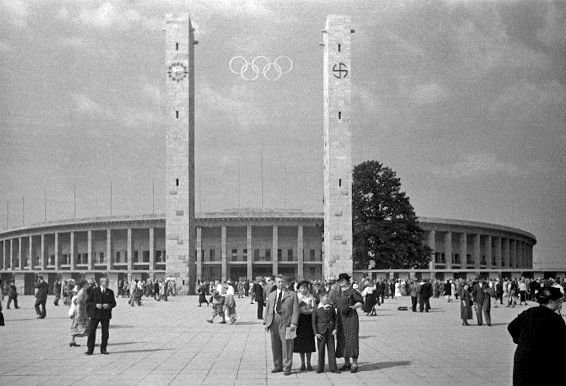
Olympische Spiele 1936 


"The sportive, knightly battle awakens the best human characteristics. It doesn't separate, but unites the combatants in understanding and respect. It also helps to connect the countries in the spirit of peace. That's why the Olympic Flame should never die."
    – Adolf Hitler, commenting on the 1936 Berlin Olympic Games


Die XI. Olympischen Sommerspiele in Berlin 1936

www.dhm.de/lemo/html/nazi/olymp/index.html
Nach den IV. Olympischen Winterspielen in Garmisch-Partenkirchen vom 6. bis 16. Februar 1936 fanden vom 1. bis 16. August in Berlin die XI. Olympischen Sommerspiele statt. Das NS-Regime verwandelte sie in ein perfektes Propagandaspektakel für das nationalsozialistische Deutschland.

Als das Internationale Olympische Komitee (IOC) die Spiele am 13. Mai 1931 an Deutschland vergab, ahnte noch niemand, daß die Weimarer Republik 1933 von einem diktatorischen Regime abgelöst werden würde. Nach der Machtübernahme der Nationalsozialisten und den ersten Akten des offenen Antisemitismus gab es daher vor allem in den USA und Frankreich Boykottbestrebungen, die von zahlreichen deutschen Emigranten unterstützt wurden. Die Nationalsozialisten, die den olympischen Gedanken der Völkerverständigung stets als "geistige Verirrung" abgetan hatten, erkannten die Chance, mittels der Olympischen Spiele einen enormen Prestigezuwachs in In- und Ausland zu erreichen.
[...]
In einer knappen Abstimmung entschied sich die nordamerikanische "Amateur Athletic Union" im Dezember 1935 gegen einen Boykott der Olympischen Spiele, die anderen Staaten folgten diesem Beispiel.
[...]
Am 1. August eröffnete Adolf Hitler die Spiele vor 100.000 Zuschauern im Olympiastadion.


The History Place - Triumph of Hitler

www.historyplace.com/worldwar2/triumph/tr-olympics...

The Games had been awarded to Germany by the International Olympic Committee back in May 1931, before Hitler came to power. It was the second time the modern Olympics were scheduled to be held in Germany. The 1916 Olympics scheduled for Berlin were canceled due to World War I.

Under Goebbels' direction, the Nazis intended to use the 1936 Summer Olympics in Berlin as a showcase for the "new Germany." The Nazis also hoped to profit from the tens of thousands of souvenir-hungry tourists who would bring much needed foreign currency into the country.


On May 13, 1931, the International Olympic Committee, headed by Count Henri Baillet-Latour of Belgium, awarded the 1936 Summer Olympics to Berlin. The choice signaled Germany's return to the world community after defeat in World War I.

Two years later, Nazi Party leader Adolf Hitler became chancellor of Germany and quickly turned the nation's fragile democracy into a one-party dictatorship. Police rounded up thousands of political opponents, detaining them without trial in concentration camps. The Nazi regime also put into practice racial policies that aimed to “purify” and strengthen the Germanic “Aryan” population. A relentless campaign began to exclude Germany’’s one-half million Jews from all aspects of German life.

The Nazification of all aspects of German life extended even to sport. A staunch Nazi close to Hitler, Hans von Tschammer und Osten, headed the Reich Sports Office, which oversaw all sports bodies and clubs, including the German Olympic Committee planning the 1936 Games.

“German sport has only one task: to strengthen the character of the German people, imbuing it with the fighting spirit and steadfast camaraderie necessary in the struggle for its existence.” — Joseph Goebbels, Minister of Propaganda, April 23, 1933

The government harnessed sport as part of its drive to strengthen the “Aryan race,” to exercise political control over its citizens, and to prepare German youth for war. “Non-Aryans” — Jewish or part-Jewish and Gypsy athletes — were systematically excluded from German sports facilities and associations. They were allowed marginal training facilities, and their opportunities to compete were limited.

For two weeks in August 1936, Adolf Hitler's Nazi dictatorship camouflaged its racist, militaristic character while hosting the Summer Olympics. Soft-pedaling its antisemitic agenda and plans for territorial expansion, the regime exploited the Games to bedazzle many foreign spectators and journalists with an image of a peaceful, tolerant Germany.

Having rejected a proposed boycott of the 1936 Olympics, the United States and other western democracies missed the opportunity to take a stand that — some observers at the time claimed — might have given Hitler pause and bolstered international resistance to Nazi tyranny. With the conclusion of the Games, Germany's expansionist policies and the persecution of Jews and other “enemies of the state” accelerated, culminating in World War II and the Holocaust.


 VIDEO
 Opening of 1936 Summer Olympic Games in Berlin.
 View Video
 AUDIO
 Listen to Jewish athlete Gretel Bergmann describe her experiences in Nazi Germany.
 View Audio
 AUDIO
 Listen to U.S. Jewish athlete Marty Glickman describe his 1936 experiences.
 View Audio
 PHOTO
 Adolf Hitler passes through the Brandenburg Gate on the way to the opening ceremonies of the Olympic Games.
 View Photo

 PHOTO
 In the Olympic Stadium, German spectators salute Adolf Hitler during the Games of the 11th Olympiad.
View Photo
 PHOTO
 At a ceremony during the 1936 Olympic Games, German spectators spell out the phrase, directed at Adolf Hitler, "Wir gehoeren Dir" [We belong to you].
 View Photo

Dispute over boycott of the Olympics in the U.S.

en.wikipedia.org/w/index.php?title=1936_Summer_Oly...

During the 1936 summer Olympics, there were many different views on whether the games should be allowed or discontinued. The people who voiced their opinions on the debate included Americans Avery Brundage, Ernest Lee Jahncke, and Judge Jeremiah Mahoney. The United States considered boycotting the Olympic games, since participating in the festivity might be considered as support for the Nazi Germany regime and its Anti-Semitic policies. However, others argued that the Olympic Games should not be a reflection of political views but strictly a contest of the greatest athletes.

Avery Brundage, President of the American Olympic Committee was against the boycott, stating that the Jewish athletes were being treated fairly and that the games should continue. Brundage believed that politics played no role in sports, and they should be considered two different entities during the controversial Olympics. He explained stating, “The very foundation of the modern Olympic revival will be undermined if individual countries are allowed to restrict participation by reason of class, creed, or race.”


1936 Nazi Color Film-Berlin in the Year of the Olympic Games


Nazi propaganda complete color film from 1936. An outstanding portrait of everyday life in Berlin in this rare, well preserved film, with the magical feeling of the pastel colors of Agfachrome.

Olympia 1936 - Fest der Völker/Feast of nations

The great opening ceremony of the 11th Olympic games in Berlin on August 1st 1936.
 

INTERNATIONAL OLYMPIC COMMITTEE - OLYMPIC GAMES

www.olympic.org/uk/games/past/index_uk.asp?OLGT=1&...
The 1936 Olympics, held in Berlin, are best remembered for Adolf Hitler’s failed attempt to use them to prove his theories of Aryan racial superiority. As it turned out, the most popular hero of the Games, was the African-American sprinter and long jumper Jesse Owens, who won four gold medals. During the long jump competition, Owens’ German rival, Luz Long, publicly befriended him in front of the Nazis.
www.olympic.org/uk/utilities/multimedia/gallery/ph...

Berlin, Olympic Stadium, August 1936, Games of the XI Olympiad. Rival competitors in the long jump, German athlete Lutz LONG, 2nd, and Jesse OWENS of the United States,1st.